
What's Love Got To Do With It?
Sunday, February 16, 2025

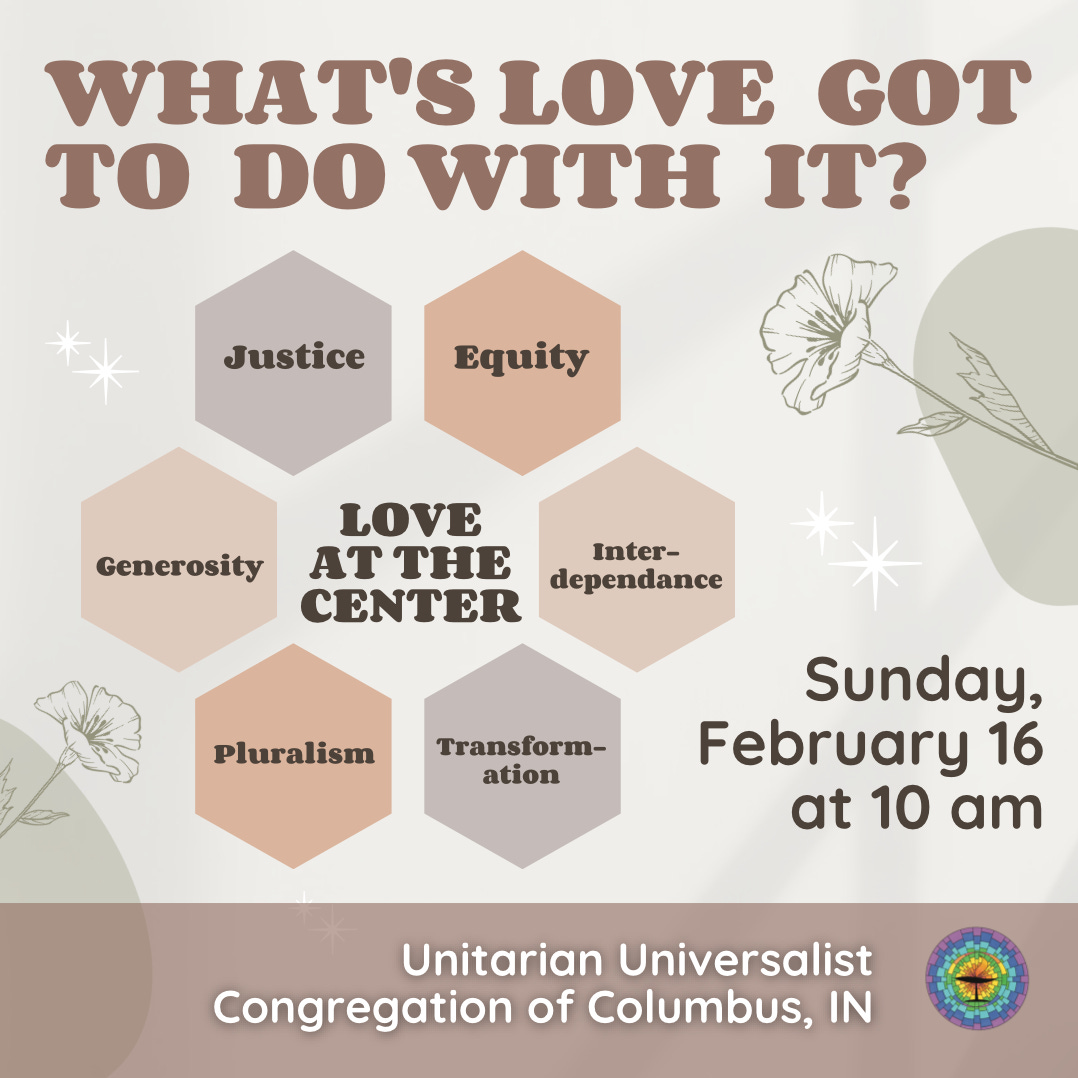
Service Blurb: While Unitarian Universalists talk a whole lot about love, what do we really mean by it? As we are called to put Love at the Center, we will explore the breadth, depth, and meaning of love as a spiritual tool for living in our world today.
This is the second of a four part series titled, “Love at the Center.” You can read the first part here:

Opening Words — Excerpt from “We All Eat Cannibals” by Skye Nicholson
What if
we knew we couldn’t live another day
without love? Would we be lying
to ourselves? The lie is thinking
love is ever controlled by someone.
Love is not a well, running
wet and dry. Love is the sun
ever-shining: behind clouds,
behind shadows, behind the backside
of night. Even in the darkness
we are pulled by its gravity. Just wait,
you fool, and dawn will come.
Reading — Excerpt from "We Call These Things Love" by Rev. Adam Robersmith
My understanding of religious community is centered in a love that must be shared to exist and grow, is powerful through relatedness, and sustains individuals while drawing them into community. I imagine an ecology of love rooted and growing within our congregations and communities, a vast interconnectedness of our own forests and oceans, plains and deserts…
Unitarian Universalism, I believe, can bring such community into being. By organizing through covenants, we affirm that relationship is at the core of our faith, that love is at the center. I have found a religious home here because we are a people of covenant, of relationship. When we are living our faith, we use our relational power to grow in a love that values and respects everything it connects.
…Love is one of those words that holds so much and yet we use it as though we all know exactly what we each mean. There are as many ways to think about the concept of love as there are people. Some of us think about it as a virtue or an ethic, others as the nature of the Sacred or the core of human relationship, and yet others as an emotion, practice, or choice…
What if what we perceive as love is also nurture and mutuality and sustainability and balance embedded in networks of relationship?…
Perhaps this is what the natural world can tell us about love: not that other beings feel love as we do, but that we can recognize love as something more than our own feelings. If love is the very best version of relatedness, then love is at the center of Life itself and networked throughout our entire existence.
Sermon — "What’s Love Got To Do With It?” by Rev. Nic Cable
When I met with Skye last week to discuss the service for today, I was a little embarrassed when she quoted a lyric that I didn’t recognize. Towards the end of our meeting she asked rhetorically, “I mean, who needs a heart when a heart can be broken?” And not knowing she was quoting a lyric of a song, I thought she was just being poetic, you know being a poet and all. And I wanted to seem cool, so I think I nodded, and was like, “yeah, you’re right, mmm… who needs a heart when a heart can be broken?” She blinked a couple times and didn’t say anything which led me to think I was maybe missing something. She paused, and then said “you know like from your sermon title, ‘What’s Love Got to Do With It?’” I realized in that moment a couple things. One, was that even though I was born in the 1980s, I had a lot to learn about 1980s pop culture! The other was that love songs are so ubiquitous that one can feel very familiar with a song’s title or a key lyric without really knowing much more than that. Like think about it for a second, love is so saturated in our popular culture and social media landscape, especially in the music industry. I read an article this week titled “Deconstructing the Love Song: How and Why Love Songs Work” and it estimates that around one hundred million love songs have been recorded. And like I don’t even need to know if that number is accurate, you know, because think about just how commons these types of songs are in genres from country to hip-hop and from jazz to opera. One hundred million is a big number; it’s sort of like infinity in that after awhile, you say, “okay, I get it! It’s a lot.” Love songs, especially around this time of Valentine’s Day, say a little bit of everything and yet a whole lot of nothing. Or at the very least one could surmise that the themes and topics, even lyrics, get a little repetitive after awhile. The article I mentioned lifts up the lyrics from a song in the 1934 broadway musical, “Life Begins at 8:40,” that shares this sentiment:
“Lovers long before us,
Sang the same old chorus,
If it worked in days of yore,
What can I say in a love song,
That hasn’t been said before?”
It reminds me of another part of my conversation with Skye about love, where we agreed that so much that we say about love can be cliche, and yet because of this over saturation of love we can either conclude that it is overblown, inflated, and thus devalue how much importance it can hold in one’s life. Or, on the other hand, we could surmise that along with the one hundred million songs recorded, the countless other books and plays and poems that have been written, or the billions of lives that have been born into this precious world, those that have experienced both overflowing joy and unthinkable woe, is this ever-present, force, power, energy, mystery, source, and resource of life that we might call love. In this sense, love is not depreciated by history’s perennial search for exploration of its true character and contours; love is not lessened by our inexplicable obsession or even our resentful rejection of it. No, instead I believe love has become so ever-present, so cliche, so overused, because we cannot escape it, we can’t get away from love, not even in the days of greatest horror and hopelessness, in times where the spark of life within each of us feels to be growing dim and vulnerable to the smallest force of wind or violence. Yes, love can never be used up so long as the earth keeps turning, the sun keeps rising and setting, and you and I and all of life that has been, is, and will ever be keeps coming in to this world with that same mysterious longing for integrity, for reintegrating, remembering our wholeness with one another and with love itself.
So, we ask this Sunday, and this month, “what’s love got to do with it?” We ask this with the backdrop of the broken heartedness of the world in which we are living, where day by day news would have us believe love is powerless and nothing but, as Tina would say, a second hand emotion. And we ask “what’s love got to do with it?” as Unitarian Universalists around the country are trying to make sense of these last few weeks in light of our renewed emphasis and centering of love at the heart of our living religious tradition. What does love have to do with Unitarian Universalism is as paradoxical as applying it to life because like the one hundred million songs on love, I would suspect that almost every Unitarian Universalist that is today and ever was chose to enter into a community such as this one because of some motivation related to love. How many of you came to UUCCI either out of a longing to find a loving community or to be around people who chose love over division, who chose to celebrate love rather than see it withheld or politicized or commoditized or weaponized for profit? Yes, so many of us seek community, including what might be a glimpse of or a precursor to Beloved Community, when we experience some dissonance between the love in our hearts with the love we experience in life. In that tension, we naturally look for resolution, release, and return to integrity, in my opinion a return to wholeness with love eternal that is the essence of all that was, is and ever will be.
Our reading from this morning came from a recently published book titled Love at the Center: Unitarian Universalist Theologies. Edited by our UUA president, the Rev. Dr. Sofia Betancourt, it is filled with 26 short meditations on love by Unitarian Universalist ministers, religious educators, musicians, and lay leaders, who collectively are beginning to answer what love has to do with Unitarian Universalism today in 2025 and for the road before us. I’d recommend anyone who is contemplating love’s place and purpose in their life to purchase a copy and allow it to be a resource of personal reflection and growth. The essay I chose to highlight was written by the Rev. Dr. Adam Robersmith who serves the Universalist Church of West Hartford, Connecticut. As an aside, back in the early 2010s when he was serving Second Unitarian Church of Chicago, he offered me some spiritual direction as I began seminary and was extremely helpful in my early development as a minister in formation. In his essay, “We Call These Things Love,” he acknowledges love’s depth and breadth, writing:
“…Love is one of those words that holds so much and yet we use it as though we all know exactly what we each mean. There are as many ways to think about the concept of love as there are people. Some of us think about it as a virtue or an ethic, others as the nature of the Sacred or the core of human relationship, and yet others as an emotion, practice, or choice…”
I expect these different ways of thinking of love resonate more or less with each of you. With all of these different ways of thinking about love that that one hundred million number may not seem so big. So while love can be thought about with an ethical lens or to describe the sacred, Robersmith invites us to think about love in the context of community, both UU and otherwise. He asks us to consider:
“What if what we perceive as love is also nurture and mutuality and sustainability and balance embedded in networks of relationship?…”
Perhaps, indeed, along with all these things we call love, in all the places hopeful and hopeless that we find love, love is that which can connect us, sustain us, and nurture us in a network of mutuality. Perhaps love whatever it may be in all the ways we may sense it, can be the ground upon which we create this community of hope and courage, again and again, Sunday after Sunday, and throughout the week, rain or shine, snow or sleet, during a time of democracy, or pandemic, or rising authoritarianism. Perhaps love can be not cliche and naive, but the bottomless wellspring of creative possibility. Like my colleague, I believe our UU communities across the country can bring such love into being. He says that “by organizing through covenants, we affirm that relationship is at the core of our faith, that love is at the center. I have found a religious home here because we are a people of covenant, of relationship. When we are living our faith, we use our relational power to grow in a love that values and respects everything it connects.” In this sense when we ask not rhetorically but earnestly “what’s love got to do with it?” we can say with some confidence… everything. Love has everything to do with it because life is relational and life is all there is; even in death, we understand love through the relationship with who or what once was; even in our dreams of the future, we understand what love is through our tender relationship of what might still be.
So my friends, as we continue to explore what it means to place love at the center of our lives, community, society, and world, may we find confidence in one another and in love itself that love is more than enough to hold us together, that love is not oil or money, but infinity embedded in each of our hearts and in the trees and snowflakes, in the laughs and tears. May this wondrous love be the source of our resilience and the energy that lights the spark of divine within each of us to live courageously in these times of great challenge. And in the end, if love is all that we have, may we know that even in that most hopeless hour, love abides and can help us find not just a way out of no way, but carve brand new paths for the streams of love that surely will flow, even and if only when the snow melts, and the sun rises once more.
May it be so. Amen.