
The Transient and the Permanent in Unitarian Universalism
Sunday, December 1, 2024

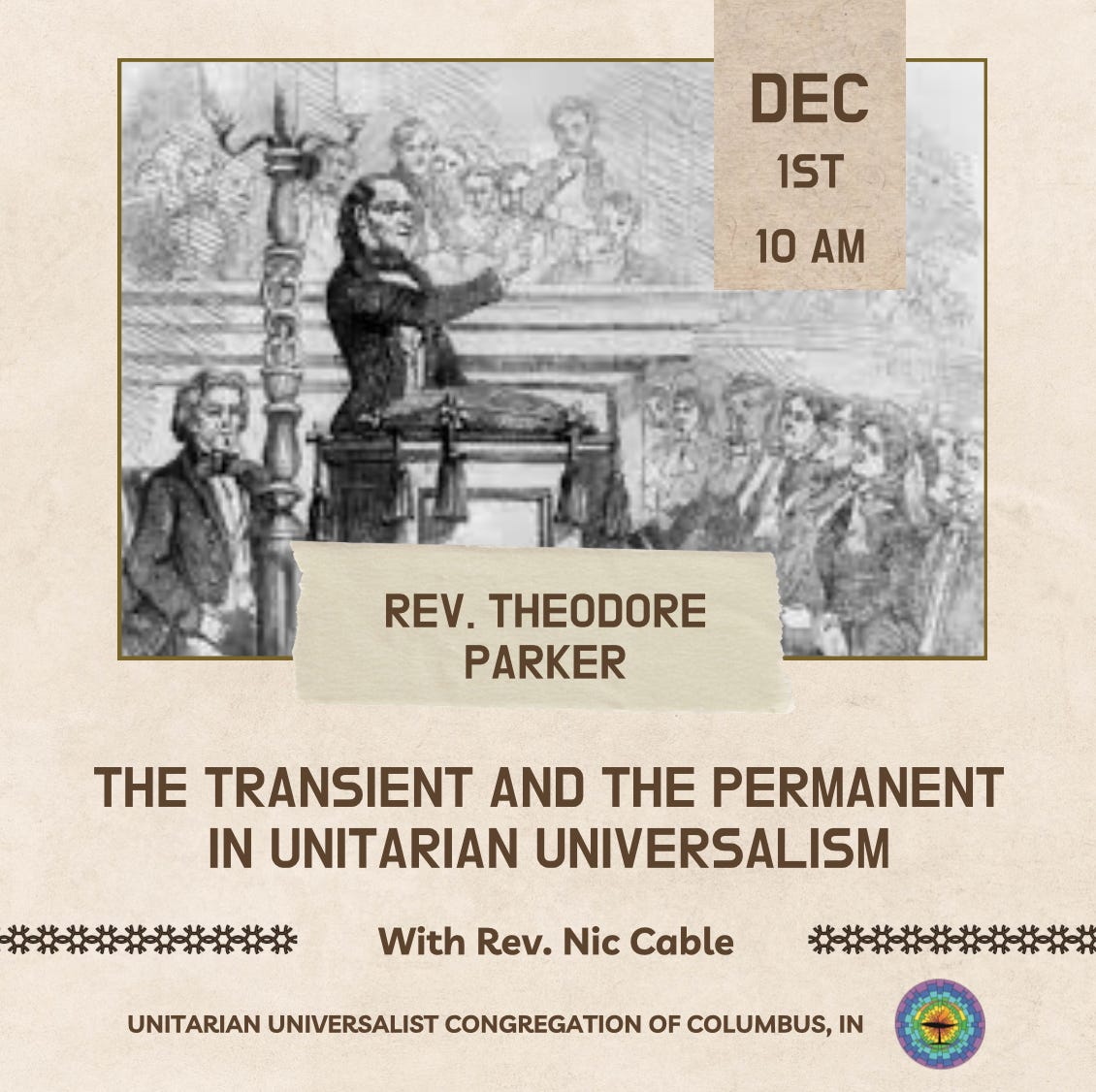
Here is the blurb for last Sunday’s service: “In 1841, Unitarian minister and abolitionist, Rev. Theodore Parker, offered what became the defining manifesto of Transcendentalist Unitarianism. At 31 years young, Parker was in the midst of a short but impactful career that continues to shape Unitarian Universalism today. But who was Theodore Parker and why was he so influential? What can we learn from his life and radical reformer ways that will aid us in this chapter of our lives in the 21st century. This year's Auction Sermon topic will focus on the life and teachings of Theodore Parker and invite us to consider anew what is transient and permanent in UUism today.”
Opening Words — “Winter As Crucible” by Katherine May
The changes that take place in winter are a kind of alchemy, an enchantment performed by ordinary creatures to survive...Plants and animals don't fight the winter; they don't pretend it's not happening and attempt to carry on living the same lives that they lived in the summer. They prepare. They adapt. They perform extraordinary acts of metamorphosis to get them through.
Winter is a time of withdrawing from the world, maximising scant resources, carrying out acts of brutal efficiency and vanishing from sight; but that's where the transformation occurs. Winter is not the death of the life cycle, but its crucible.
Reflection — Missy McAdams
When I first discovered the UU church after a lifetime of religious manipulation, I was so relieved to find a genuinely loving and accepting congregation that I never stopped to question the church’s history. I joined the church under the assumption that the breadth of its history was maybe a group of free spirits in the 60’s with a dream. Obviously this perception didn’t bother me because here I am, a proud member. I’m happy to say that I’ve since learned that the history here is drastically more significant and long lived than I had originally thought.
The origin story of the UU church is filled with compassionate visionaries who fought against popular thought patterns in their own eras. Today you will learn about only one of them but there are so many more to explore and thankfully many of their writings survive today. I guess some people might feel foolish for making assumptions that turned out to be wildly untrue but I’m glad to be proven wrong. I am comforted to know that there is a rich history here. The fact that we have history means that we’re not the first humans, or even the first Americans, to look around and say “This isn’t right and I want to change it”.
The early predecessors of the UU church have existed for hundreds of years. And the ideas that they wrote about existed long before them. The Unitarian Universalist Association may have formed in 1961, so I was actually a little bit right about the hippies, but the movements that produced the UUA are far older. The first official Unitarian church was formed in 1774, while the idea of Universalism emerged shortly after the death of Jesus of Nazareth.
We’ve been through tough times before with our humanity intact and we will do so again. I don’t have a time machine and I’m no expert in human evolution but I have a feeling that us “bleeding hearts” have always been here. I bet even the cavemen had a few tree huggers who kept bringing furry little rescues back to the cave. The history books often don’t do a great job of documenting people like us but we have always been here. Our belief that every human life is sacred and true peace is possible is not new, and that comforts me greatly.
There’s a deep feeling of dread for a lot of people right now. A fear of what they see coming and feel powerless to stop. But none of us are an army of one. You’re not the only one panicking, you’re not the only one who’s scared, and we’re not the first generation to face these threats. We have a millennia of compassionate ancestors behind us. To know that there have always been people standing in opposition to war, to genocide, to fascism, to slavery, at all the darkest points of human history, gives me hope. It’s a hope that there are far more of us than anyone realizes and that our army is out there.
Reading — Excerpt from “The Transient and the Permanent in Christianity” by Rev. Theodore Parker
To turn away from the disputes of the Catholics and the Protestants, of the Unitarian and the Trinitarian, of Old School and New School, and come to the plain words of Jesus of Nazareth, Christianity is a simple thing; very simple. It is absolute, pure Morality; absolute, pure Religion; the love of man; the love of God acting without let or hindrance. The only creed it lays down is the great truth which springs up spontaneous in the holy heart -- there is a God. Its watchword is, be perfect as your Father in Heaven. The only form it demands is a divine life; doing the best thing, in the best way, from the highest motives; perfect obedience to the great law of God. Its sanction is the voice of God in your heart; the perpetual presence of Him, who made us and the stars over our head; Christ and the Father abiding within us. All this is very simple; a little child can understand it; very beautiful, the loftiest mind can find nothing so lovely. Try it by Reason, Conscience, and Faith -- things highest in man's nature -- we see no redundance, we feel no deficiency. Examine the particular duties it enjoins; humility, reverence, sobriety, gentleness, charity, forgiveness, fortitude, resignation, faith, and active love; try the whole extent of Christianity so well summed up in the command, "Thou shalt love the Lord thy God with all thy heart, and with all thy soul, and with all thy mind -- thou shalt love thy neighbor as thyself;" and is there anything therein that can perish?...
Sermon — “The Transient and the Permanent in Unitarian Universalism” by Rev. Nic Cable
About a week ago, I was speaking on the phone with Missy about the service we were planning for today and to my gratitude she expressed her interest in not only the specific topic of the 19th century Unitarian minister and abolitionist, Theodore Parker, but of Unitarian Universalist history, in general. You see, as she noted in her reflection this morning, it is easy and common for the vast majority of you who become Unitarian Universalists as adults, you who join in the living tradition, the flowing stream of liberal and liberating religion to merely look forward at the journey ahead, rather than backwards at the rich history upstream from whence the waters in which we now wade once came. Ah yes, to her and my perpetual gladness, Unitarian Universalism is a part of the large flowing aqua-logical system of life, to those rivers and seas, streams and creeks, those watersheds and deep basins, lakes and ponds, indeed to all the tributaries of these nourishing waters of our common life. We don’t merely seek to be shapers of history, as the late Rev. Dr. Gordon McKeeman encouraged us to be. Yes, we are not only shapers of history, but we are keepers of history, as well, keepers of our living tradition, that is passed over and down, forward and up to each new generation by age or arrival of those who enter into the loving embrace of Unitarian Universalism.
And so here we are. Keepers of history. Shapers of history. But, we must take up one more task if we are to claim these corresponding responsibilities. Any ideas? Yes, if we are to be keepers and shapers of history, we must surely be knowers of history in the first place! We must know our history if we are to bear it, carry it, if we are to keep the flame alive, let alone allow it to guide what paths we may take in this uncertain time we find ourselves today. So I am thankful this morning that Mark Kevitt chose a person and topic that is situated deeply within the heart of our Unitarian religious heritage. There are an infinite number of limbs, branches, and leaves you could have chosen, but to my gratitude you chose a person who lived at such a consequential time in both Unitarian and United States history, indeed one who was a shaper of both histories, the implications of which we may feel if we know where to look today.
It cannot be overstated: Theodore Parker is one of the most impactful and transformative religious leaders in our living tradition. He lived and ministered at a time when a limb of the great tree of life was preparing to split into two branches in both our Unitarian and US history. In the limited time I have this morning I hope to speak to both critical eras in these interwoven histories that run approximately between 1840 and 1860, but with particular priority given to our Unitarian history as it may help us consider today some of the big questions and challenges we face in our country today.
So it is important to understand the time and place in which Theodore Parker lived and ministered. Born in Lexington, Massachusetts, in 1810 he lived and came of age in the highest concentration of Unitarians in the United States. The greater Boston area is brimming with Unitarian history. When I was a 9th grader, I went on a UU history trip with my youth group and learned so much about our spiritual forbears. Despite being immersed in such history, Parker was not always destined to become a minister, in fact he grew up with many anti-clerical sentiments that turned him off of organized religion for the most part. However, in time he warmed to the idea, especially due to the growing belief that the position of minister and the profession of ministry especially through the vehicle of preaching and congregational life can be sources of social transformation. You see, Parker was deeply committed to the betterment of society which went hand in hand with the betterment of the individual, of the sharpening of the mind, the opening of the heart to greater affection for one’s neighbor, and the nourishing of the soul and one’s religious convictions. Parker also came of age in the aftermath of three significant events including the founding of Harvard Divinity School in 1816, followed by William Ellery Channing’s most famous articulation of the character and definition of Unitarian Christianity in 1819, and finally the creation of the UUA’s predecessor organization the American Unitarian Association in 1825. All of this led eventually to his enrollment at Harvard in 1834 for his formal preparation for the Unitarian ministry.
Yet a lot would unfold in the years prior to Parker’s seminal work which was excerpted in our reading today and to which this sermon title alludes. Theodore Parker was at Harvard Divinity School from 1834-1837. During this time he came across the writings and ministry of Ralph Waldo Emerson, most notably his 1836 publication of arguably Emerson’s most famous and controversial work titled Nature. A brief but important aside: Nature for all intents and purposes marked the birth of what became known as Transcendentalism. And transcendentalism and the transcendentalists represented the second major American religious controversy as it relates to the Unitarians in our still young life as a nation and religious tradition in the United States. We love a good controversy! But Nature really took Boston and the liberal religious world by storm. And then the storm got bigger. In 1838, just a year after Theodore Parker graduated from HDS, the commencement speaker was none other than, you guessed it, Ralph Waldo Emerson. It was at this ceremonial send-off of new liberal clergy into the world that the final catalyzing event shaped the context or history that ushered Parker into the 1940s, the era of import for this morning, and the brief but consequential two decades of his ministry and activism. Known simply as the “Divinity School Address,” Emerson outlined his criticism of Unitarianism of the day. Less then two decades after Channing created a bold statement that shone a bright light on the future of Unitarianism, Emerson brought a wet blanket to the party. While great unpacking should be done for both Channing and Emerson’s notable treatises, we do need to be getting to the star of the hour. In consolation, I would commend you the book, Three Prophets of Religious Liberalism, which includes all three primary texts and an excellent introduction for context. Again, it is called Three Prophets of Religious Liberalism.
In many regards, “The Transient and the Permanent in Christianity” best articulates the struggle between, on the one hand, the Unitarian establishment, still just recently freed from the congregationalist orthodoxy of New England, and, on the other, the renegade transcendentalists, as embodied by Emerson, compared to Emerson’s own often ecstatic, eclectic, and esoteric writing style. In fact, I think the essential value of Parker’s contribution is found no deeper than in the title itself. For what Parker offered his contemporaries and all of us 183 years later was a reminder and encouragement to consider that the essence of something as big as Christianity, or of Unitarian Universalism today, consists of transient elements and permanent elements. On May 19, 1841, at the ordination of the Rev. Charles C. Shackford, Theodore Parker outlines with at once careful precision and rhetorical simplicity what he sees as the transient or fleeting qualities of Christianity and those that are permanent, essential, or eternal to the religion. While Parker shared much of Emerson’s criticisms of Unitarianism, he was less prepared to throw the baby out with the bath water. Parker still saw a central supremacy of the Christian narrative and didn’t go as far as Emerson who sought to decenter it for a post-Christian transcendent, universal spiritual worldview.
In short, “The Transient and the Permanent in Christianity” can be differentiated by what Parker saw as things that were original to the teachings of Jesus and to those that were later created developed by humans. He deplored the divisions and petty fractures in his mind between the increasingly diversifying protestant landscape. He saw the differences among the ecumenical community to be based on cultural, practical, doctrinal, and ephemeral qualities that have know inherent value compared to the essential, permanent, and eternal truth that Christianity espouses. Parker writes,
“To turn away from the disputes of the Catholics and the Protestants, of the Unitarian and the Trinitarian, of Old School and New School, and come to the plain words of Jesus of Nazareth, Christianity is a simple thing; very simple. It is absolute, pure Morality; absolute, pure Religion; the love of man; the love of God acting without let or hindrance. The only creed it lays down is the great truth which springs up spontaneous in the holy heart -- there is a God.”
The universalism Parker promotes here may feel like a minimization of difference or an over simplification based on our experiences living in the 21st century. But here is an interesting example of what separates transcendentalism and unitarianism and remains a dynamic we face today. In an article titled “The Political Ideas of Theodore Parker” Arthur Ladu argues that Parker’s interest and involvement in politics went hand in hand with awakening to a transcendentalist worldview. According to Ladu, Parker saw consciousness as superior to experience. Parker writes,
“He that is true to conscience, faithful to reason, obedient to religion, has not only the strength of his own virtue... but the whole strength of omnipotence on his side;... Thus man partakes the divine nature… What is universal, absolute, true; speaks out of his lips, . . .”
Parker writes elsewhere, “In politics, transcendentalism starts not from experience alone, but from consciousness; not merely from human history, but also from human nature. It does not so much quote precedents, contingent facts of experience as ideas, necessary facts of consciousness. . . . It appeals to a natural justice, natural right, absolute justice, absolute right.”
There we hear that allusion to Emerson and Nature just a few years prior. Due to this orientation, it is no surprise Parker became an adamant abolitionist, seeing human freedom as an absolute right, and the institution of slavery as an absolute injustice. His teaching and preaching in the 1840s solidified this stance as the United States became increasingly divided barreling perhaps inevitably toward a Civil War. 1850, the beginning of Parker’s last decade of ministry in his young life, represented a possible compromise solution in the form of the Fugitive Slave Law. However, opponents of the legislation, including Parker, saw the writing on the wall: this issue had no compromise, it would not last, we would not last as a nation. Said differently, in the words of the newly nominated republican candidate for US Senate from Illinois, Abraham Lincoln, “‘A house divided against itself, cannot stand.’ I believe this government cannot endure permanently half slave and half free.”
Theodore Parker’s ministry in the 1850s included the co-founding of the Vigilance Committee in Boston to be in solidarity with “the colored inhabitants of Boston from any invasion of their rights,” most notably the re-abduction by “officials” from the south sent to retrieve what some falsely viewed as property. No the Vigilance Committee was one of many radical acts of ministry and social justice engaged by Parker to resist the creep of complicity to and participation in the slavery industrial complex in the north. In response to one incident related to Ellen and William Craft who arrived after a treacherous journey to Boston in 1849. After the officials were harassed and eventually gave up and went home, Theodore Parker wrote a scathing letter to President Millard Fillmore, the signer of the Fugitive Slave Law who also happened to be a Unitarian. Fillmore was an apologist and hoped to compromise or endure the era until a resolution would peacefully come. In a gripping image and rhetorical crescendo, Parker wrote in his letter to Fillmore, “There hangs in my study . . . the gun my grandfather fought with at the battle of Lexington... and also the musket he captured from a British soldier on that day… If I would not peril my property, my liberty, nay my life to keep my parishioners out of slavery, then I should throw away these trophies.”
Parker lived with this life or death mentality. He was a workaholic and it likely played a part in his early demise. He once wrote in his journal in 1840, still at the beginning of his career, “I must do or die.” Yet 20 years later as he prepared to die, having just relocated to Italy, he told his fellow Unitarian minister, George Ripley, “I am conscious that I leave half my work undone… Much grain lies in my fields.” Indeed, Parker would never experience the pain of the Civil War or the liberation from slavery that came following its conclusion. Much debate surrounds whether Lincoln ever met Theodore Parker, but it is so evident that he was influenced by the progressive religious spirit who saw through the transient toward the permanent and essential truth and value of liberal religion. Parker’s writings influenced not only President Abraham Lincoln, but also Dr. Martin Luther King Jr. a century later in the 20th century, and President Barack Obama in the 21st.
All of this is to say the following. Theodore Parker deserves our deepest gratitude and continued study, for in his writing or even proposing that some things in our religion or society are transient and others are permanent, we are called to such rigorous consideration and action in our lives today. As individuals, families, as a congregation, a city, a region, as a state and nation, we are asked to get really serious, like deathly serious, and cut through the paraphernalia of life so that we may uplift the pure, absolute, and glorious virtues and rights worthy of our steadfast celebration and commitment.
As a congregation, when we talk about our mission or vision, of a strategic plan or objectives, this is not about getting corporate, its about getting real that we can either be a transient blip on the timeline of history or a permanent branch in the deviation from one road to one another. That branch, that road we may journey, the less travelled one indeed, may prove to be make all the difference in our lives and those we come to love in this life. Theodore Parker knew his history, held it gently, and chose to shape it towards a more righteous future where all could experience the beauty and joy of life. We, too, are here pointing toward the bicentennial of Parker’s great ministry, can and must convict ourselves to the work of furthering a mission and vision worthy of our name, Unitarian Universalist.
May we find such courage and conviction to make it so. Amen.